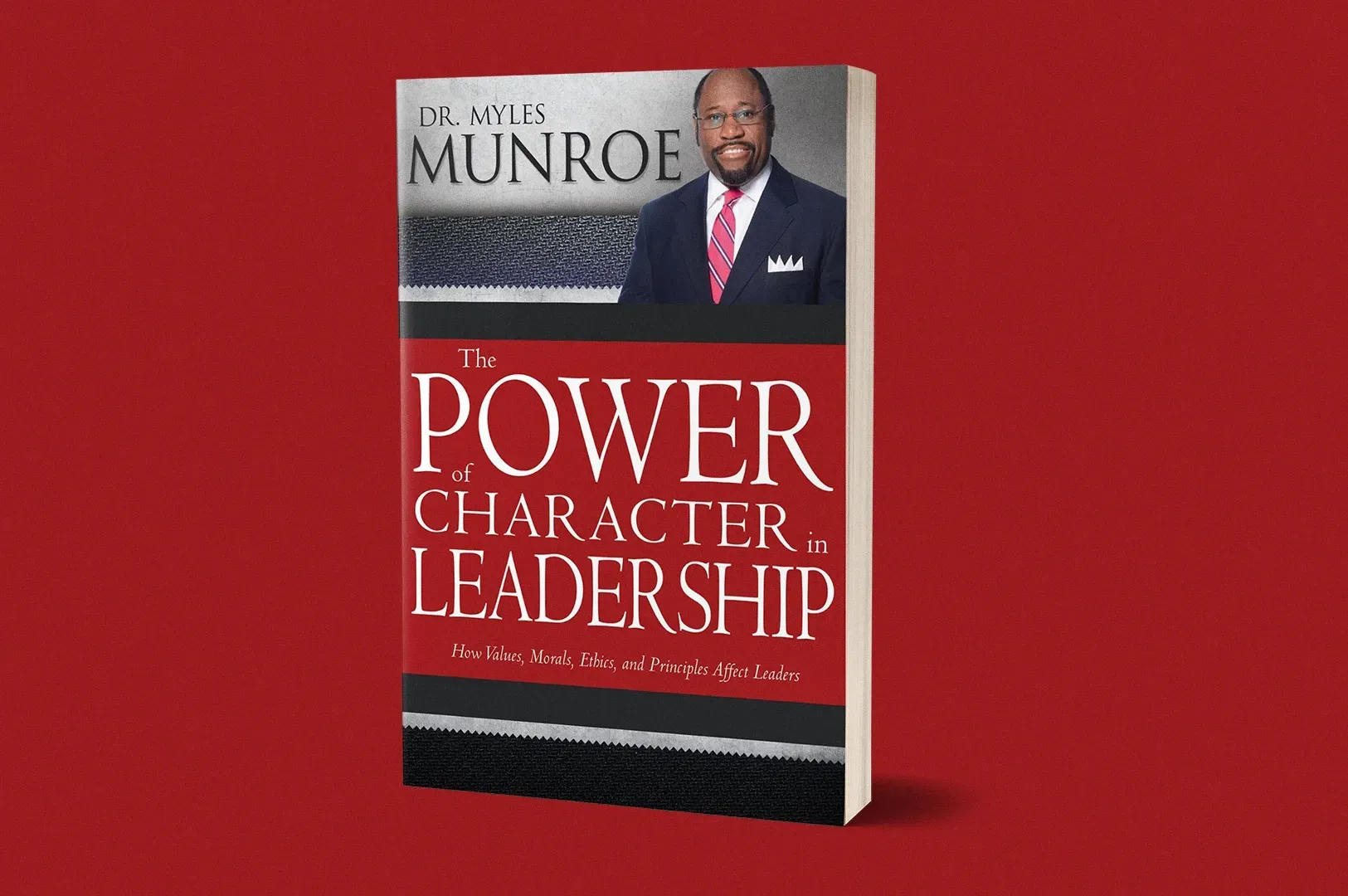



The Power of Character in Leadership by Myles Munroe | My Quiet Empire Book Review

Bay San

We often fall into the trap of believing that business culture can be engineered. We write mission statements, print core values on breakroom walls, and launch internal campaigns. Yet, the lived experience of building a company teaches a much quieter, harsher truth. Culture is simply the sum of small, repeated decisions. It is shaped by what a team actually rewards, ignores, and tolerates on a random Tuesday afternoon.


I picked up The Power of Character in Leadership by professor Myles Munroe to better understand this quiet formation. Munroe spent his career studying how humans navigate moral complexities in their daily lives. Rather than offering a rigid ethical system, he suggests that character is formed through ordinary choices, the specific stories we absorb, and the examples we choose to follow.

Close-up, slightly overhead shot of hands turning the pages of an open book placed among other books on a table, highlighting focused reading, learning, and knowledge study in a calm indoor setting.

Munroe emphasizes that moral life happens in the mundane details. He writes, "The intellect can grow and grow, but the character can remain stunted." This line stopped me completely. In the business world, we relentlessly hire for intellect. We screen for cognitive horsepower and strategic brilliance. But high intellect without a foundation of character often creates toxic organizations. Munroe illustrates how institutions actively strengthen or erode our moral foundation through their hidden incentives. When a company claims to value integrity but quietly promotes the top performer who cuts ethical corners, the true culture is set instantly.


Munroe relies heavily on case-study storytelling. He adopts a remarkably humane, listening stance. He does not preach from a podium. Instead, his essayistic voice invites us into the messy lives of ordinary people trying to do the right thing. This approach builds a deep moral seriousness because it reflects reality. Life rarely presents us with clear villains and heroes; it presents us with competing loyalties and difficult trade-offs.

Medium-wide, eye-level shot of a workplace meeting where a professional sits at a desk reviewing documents on a laptop while colleagues stand nearby, illustrating teamwork, collaboration, and leadership decision-making in an office environment.

There is, however, an honest point of tension in his approach. Because Munroe leans so deeply into personal anecdotes and individual moral agency, the book can sometimes feel disconnected from modern structural realities. He occasionally under-addresses the immense systemic pressures that constrain moral choice in today's workplaces. When an operator faces brutal investor demands, crushing margins, or the necessity of sudden layoffs, individual moral reflection meets a very hard wall. Doing the "right" thing in a heavily compromised system is far more complicated than a simple failure of personal character.


Despite this limitation, the book is a vital grounding mechanism. It is written for the builder, the manager, or the founder who suspects that true leadership is a matter of daily moral attention rather than public relations. It strips away the corporate jargon and asks us to look closely at our actual habits. It leaves behind a lingering, uncomfortable question: If our character is merely the sum of the small choices we make when we are tired and under pressure, what kind of culture are we truly building?

More Book Reviews

Straight-on eye-level shot of the book cover “Deep Work” by Cal Newport, showing minimalist typograp
By Bay San May 1, 2026
Focus is not a productivity hack; it is a structural advantage. Discover how Cal Newport’s rules for deep work shape business, craft, and quiet mastery.
Overhead top‑down shot of the book Shop Class as Soulcraft: An Inquiry into the Value of Work by Mat
By Bay San April 17, 2026
Manual competence offers a profound form of freedom. Discover how Crawford’s meditation on skilled work shapes our approach to business, craft, and character.
Straight-on product shot of the book cover “Zen and the Art of Motorcycle Maintenance” by Robert M.
By Bay San April 10, 2026
Quality is not an accident; it is a discipline. Discover how Pirsig's meditation on maintenance shapes our approach to business, craft, and quiet mastery.
Three-quarter angle product shot of The Book of Joy by the Dalai Lama and Desmond Tutu, showing mult
By Bay San April 8, 2026
Joy is not a fleeting emotion but a disciplined practice. Discover how two spiritual leaders offer a framework for resilience in business and life.
Book titled ‘Wabi-Sabi for Artists, Designers, Poets & Philosophers’ on a blue background, featuring
By Bay San March 27, 2026
On embracing imperfection: Leonard Koren's meditation on wabi-sabi offers a framework for creation that honors transience over permanence. A reflection on building with constraint.
Vintage copy of ‘The Gastronomical Me’ by M.F.K. Fisher standing upright on a wooden surface with a
By Bay San March 20, 2026
On appetite as philosophy: Fisher's memoir reveals that how we eat reflects how we live. A meditation on attention, pleasure, and intentional living.
Book cover of ‘Originals: How Non‑Conformists Move the World’ by Adam Grant displayed in front of as
By Bay San March 13, 2026
Can originality be systematized? Adam Grant's research offers tools for fostering innovation, but the most transformative work may resist frameworks entirely.
Cover of Viktor Frankl’s book ‘Man’s Search for Meaning’ placed on a wooden table beside a cup of co
By Bay San March 6, 2026
Frankl's testament from Auschwitz: meaning, not happiness, sustains us. A reflection on purpose as the foundation of resilience in business and life.
The book ‘The Art of Stillness’ by Pico Iyer placed beside a laptop in a calm, minimalist workspace.
By Bay San February 27, 2026
On the discipline of withdrawal: Iyer reveals that stillness is not escape but focus; choosing where attention goes. A reflection on strategic quiet.
Hardcover book titled The Craftsman by Richard Sennett, shown standing upright with a black cover fe
By Bay San February 20, 2026
On mastery through practice: Sennett reveals that craft is not nostalgia but discipline; doing something well, for its own sake. A reflection on patient excellence.
Show More